Key Takeaways:
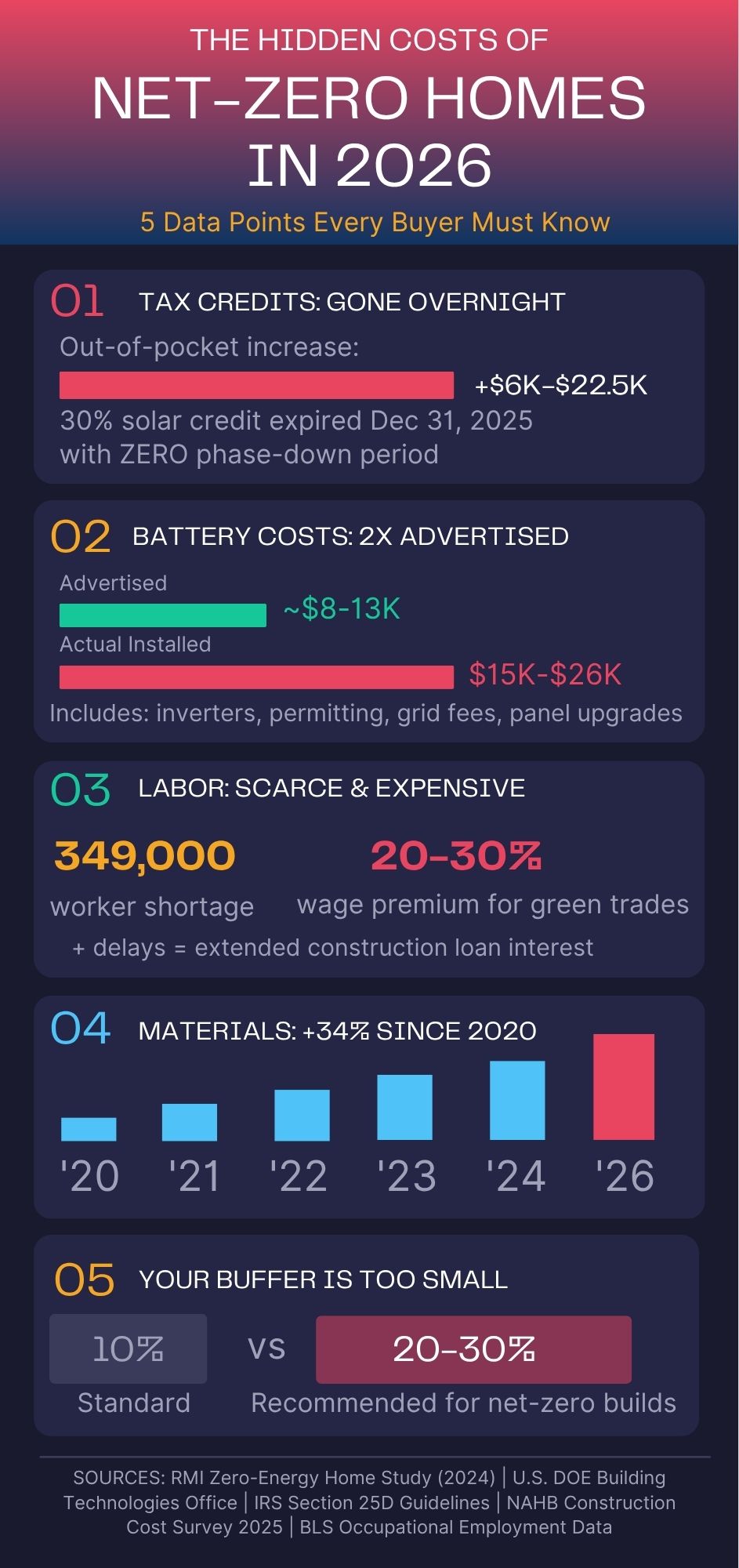
- Federal tax credits vanished overnight. The 30% solar and home efficiency credits expired December 31, 2025 with zero phase-down, adding $6,000–$22,500+ to what net-zero buyers now pay out of pocket.
- Battery storage true costs are double what’s advertised. Hardware sticker prices exclude inverters, permitting, grid fees, and panel upgrades — pushing real installed costs to $15,000–$26,000.
- Specialist labor is scarce and expensive. Green trades command 20–30% wage premiums in a market already short ~349,000 workers, and schedule delays compound the cost through extended construction loan interest.
- Material costs carry hidden, open-ended risk. Construction inputs are up 34% since 2020, and many contracts now include tariff-adjustment clauses that pass future price increases directly to the buyer.
- Your contingency fund is probably too small. Standard 10% buffers are inadequate for net-zero builds — 20–30% is the appropriate range because the systems are interdependent and remediation after a failed test costs far more than prevention.
The promise is seductive: a home that produces as much energy as it consumes, eliminating your utility bill and your carbon footprint in one move. But the sticker price of going net-zero in 2026 is no longer the whole story — and the gap between what builders quote and what buyers actually pay has never been wider or more consequential.
Here is the essential truth most sales materials skip: the federal tax incentives that once softened the blow of net-zero construction are largely gone, a construction labor shortage is pushing specialized trade wages to decade-high premiums, and tariff-driven material costs have risen roughly 34% since 2020. Understanding where the real costs hide — before you break ground — can be the difference between a smart long-term investment and a painful budget crisis.
The “Modest Premium” Myth: What the Headline Numbers Miss
Industry data regularly cites an encouraging figure: net-zero and zero-energy homes cost only a modest percentage more than code-built construction. RMI research across four major U.S. cities found that the average incremental cost of building a zero-energy home sits around 7.3%, and just 1.8% more for a zero-energy-ready home. The Department of Energy similarly notes that with careful design and after incentives, a high-performing home may run only 4% to 8% above a comparable code-built house.
Those numbers are real — but they come with asterisks the size of solar panels.
First, the baseline comparison matters enormously. A 7% premium on a $400,000 home is $28,000 before you factor in the specialized systems, third-party certifications, commissioning costs, and bespoke contractor fees that often don’t appear in the per-square-foot estimate. Second, those figures reflect controlled studies using experienced high-performance builders. The cost premium for Passive House and net-zero construction varies between 0% and 15% depending on building type, team experience, and market conditions — and for most homeowners hiring into an unfamiliar specialty, you are not on the low end of that range.
Third — and most critically in 2026 — the incentive landscape that made those numbers palatable has fundamentally shifted.
Hidden Cost #1: The Federal Tax Credit Cliff
For years, the 30% federal Residential Clean Energy Credit (Section 25D) was the financial backbone of net-zero home economics. A homeowner installing a $25,000 solar array could claim a $7,500 federal tax credit. A battery system costing $12,000–$15,000 was eligible for an additional $3,600–$4,500 reduction in tax liability.
That credit expired for homeowner-owned systems on December 31, 2025, with no phase-down period — the value dropped from 30% to zero overnight under the One Big Beautiful Bill Act passed in July 2025. The Energy Efficient Home Improvement Credit (Section 25C), which covered 30% of costs for heat pumps, insulation, windows, and electrical panel upgrades, also ended simultaneously.
For residential battery installations specifically, the termination was absolute: homeowners installing storage systems in 2026 receive no federal tax credit whatsoever. For a typical residential battery installation of $12,000–$15,000, that expiration represents $3,600–$4,500 in vanished direct tax savings.
There is a narrow remaining pathway: third-party-owned solar systems (leases and power purchase agreements) continue to qualify for the commercial 48E credit through 2027, provided construction begins before July 4, 2026. The credit goes to the leasing company, which can pass savings through lower monthly rates. But for homeowners who want to own their systems outright — historically the financially superior long-term position — that route is closed.
The practical impact is significant. Without the 30% credit, a homeowner’s overall solar cost is roughly 30% higher, and payback periods extend by several years. For new net-zero builds incorporating solar plus battery storage, the total after-credit price of the energy systems alone can be $15,000–$30,000 higher in 2026 than it would have been in 2025.
On the builder side, some relief persists: certified homes under the DOE Efficient New Homes program remain eligible for the 45L tax credit — up to $5,000 per dwelling unit — but only for homes acquired before July 1, 2026. After that date, this credit also expires. If your build timeline is already running long, you may have missed the window entirely.
What to budget: Add $6,000–$22,500 to your net-zero cost estimate to account for the loss of federal credits that would have applied just 12 months ago.
Hidden Cost #2: Battery Storage — Where the “All-In” Price Surprises Most Buyers
Battery storage is increasingly non-negotiable for a true net-zero home. Without it, any surplus solar energy is exported to the grid at rates far below what you pay to import power — often 3–7 cents per kWh sold versus 12–18 cents per kWh purchased. The math on solar-only systems has deteriorated as net metering policies tighten nationwide.
The advertised price of a battery system and the installed price are very different numbers. A typical 13.5 kWh home battery system costs around $15,228 before incentives in 2026, working out to roughly $1,128 per usable kilowatt-hour installed. But that number typically covers only the battery hardware itself.
The full project cost adds layers most quotes bury: inverter equipment, backup gateway hardware, a critical loads panel, electrical labor, permitting fees, and grid interconnection fees. Regional labor differences alone can swing the labor line by more than $1,000, and grid interconnection fees from your utility typically add another $200–$500, with some utilities taking 4–12 weeks to process approvals — weeks during which your installed system generates no return.
Homes that need an electrical panel upgrade before a battery can safely connect face an additional $500–$2,000+ in costs. For a complete installed residential storage system, total project costs range from $9,000 to $26,000+ depending on capacity, chemistry, location, and backup scope — and without the federal tax credit that expired at year-end 2025, that full amount lands on the homeowner.
One encouraging data point: battery pack prices have fallen significantly, hitting approximately $70/kWh at the storage cell level — a 45% drop from 2024. But the “soft costs” — installation labor, permitting, interconnection, and installer margin — have not fallen at the same rate, and they increasingly represent a larger share of the total project price.
What to budget: Plan for $15,000–$26,000 for a properly sized solar-plus-battery system before any remaining state or local incentives, up from the effectively lower net cost in 2025.
Hidden Cost #3: The Labor Premium for Specialized Green Trades
Building a net-zero home is not the same as building a conventional one. It requires contractors who understand blower-door testing protocols, continuous insulation installation, heat recovery ventilator (HRV) systems, airtightness sequencing, and the precise coordination required to hit certification benchmarks. These are not skills most residential builders carry as standard.
The construction industry in 2026 is grappling with a structural labor shortage that predates the net-zero premium but severely amplifies it. Industry estimates indicate the construction sector needs approximately 349,000 net new workers in 2026 just to maintain equilibrium between supply and demand, with that number climbing to 456,000 in 2027. About 94% of contractors report difficulty filling open positions.
Construction wages are up more than 4% year-over-year, and in high-demand markets and specialized trades, increases of 9–11% are common. For the specialized trades required in high-performance residential construction — advanced HVAC technicians certified in heat pump systems, airtightness specialists, and building performance analysts — the premium over standard labor rates can be considerably higher.
In competitive markets where projects are stacking up, skilled trades can command 20–30% premiums as contractors bid against each other for the same limited workforce. The net-zero home requires more of these trades and more coordination between them than a standard build, compounding the impact.
Beyond the direct wage premium, schedule risk is a hidden cost multiplier. When a blower-door test fails — revealing airtightness deficiencies that must be remediated before walls close — the labor to find and seal those leaks, reschedule inspections, and potentially delay subsequent trades can erase weeks of progress. Builders experienced with high-performance assemblies deliver more consistent test results, but their schedules are typically booked further out, which may mean extended construction loan interest costs for the owner.
What to budget: Add a 15–25% labor premium over standard-build estimates for high-performance-specific trades, and include a buffer for potential schedule overruns.
Hidden Cost #4: Certification, Testing, and Commissioning Fees

Net-zero isn’t just a design intent — it’s a verified performance standard. That verification costs money that few project budgets capture explicitly.
Third-party certification through programs like PHIUS+, ENERGY STAR, or DOE Efficient New Homes requires energy modeling before construction to simulate performance, third-party inspections during construction, and final blower-door and duct-leakage testing at completion. Associated fees typically range from $2,000–$5,000, though complex projects or locations with few qualified energy raters can push costs higher.
A standalone blower-door test for a single-family home runs $200–$450, but net-zero homes often require multiple tests: one mid-construction to catch problems before enclosure, and one at completion for certification. If results require remediation — and on first-time builds with less experienced contractors, they often do — the cost of sealing, retesting, and scheduling re-inspection adds up quickly.
Then there are the energy modeling and commissioning fees. A qualified building energy modeler must run simulations to verify that your design will actually meet net-zero thresholds before a single board is laid. Commissioning of the mechanical systems — the heat pumps, HRV, controls, and solar array — ensures everything works as designed. These are not optional for certification, and combined they can add $3,000–$8,000 or more to total project costs.
For buyers seeking the DOE Efficient New Homes label, the timeline pressure matters here too. Certified homes must be acquired before July 1, 2026 to qualify for the 45L tax credit. Any build that slips past this date — a real possibility given labor and supply chain pressures — forfeits that $5,000 per-unit credit alongside its certification investment.
What to budget: Set aside $5,000–$13,000 for certification, modeling, testing, and commissioning, and treat this as a fixed cost rather than a discretionary one.
Hidden Cost #5: Tariff-Driven Material Price Volatility
The structural components that make a net-zero home perform — triple-pane windows, thick continuous insulation, high-efficiency heat pumps, solar panels, and copper wiring — are disproportionately exposed to trade policy volatility. Overall construction input costs have risen roughly 34% since December 2020, and tariffs on steel, aluminum, and some copper products — reaching 50% in certain categories — are showing up directly in bid prices.
Baseline construction cost escalation in 2026 is expected to run between 4% and 6%, with higher increases in tariff-sensitive or labor-intensive trades. For net-zero builds that are heavily weighted toward those exact categories — electrical, mechanical, and envelope systems — the escalation on specific line items can far exceed the headline average.
The volatility itself generates a hidden cost mechanism. When material prices fluctuate between bid and completion, it creates insurance valuation gaps and may trigger change orders that were not in the original contract. Some contractors have begun incorporating tariff-adjustment clauses into contracts that explicitly pass price increases to the owner — a practice that protects builder margins but transfers an open-ended risk to the buyer.
Solar panels specifically face a complex tariff environment driven by new Foreign Entity of Concern (FEOC) rules introduced under the One Big Beautiful Bill, which restrict credits for components linked to Chinese manufacturing. These rules directly affect battery storage projects seeking the remaining 48E commercial credit, and may influence which products can be installed in credit-eligible TPO arrangements.
What to budget: Treat material estimates as provisional, not fixed. Build a 10–15% material contingency into your budget for tariff-sensitive categories, and confirm in writing whether your contractor’s quote is fixed-price or subject to escalation clauses.
Hidden Cost #6: Extended Rate Lock Fees and Construction Financing
Net-zero homes take longer to build. The precision required for airtight envelopes, the sequencing demands of mechanical systems, and the likelihood of testing-related remediation all stretch timelines beyond standard residential construction. That time costs money in the financing column.
Mortgage interest rates have fluctuated significantly over the past three years, reaching as high as 7.8% and dropping to around 5.9% for 30-year fixed products. Rate lock extensions — which guarantee your mortgage rate for a longer period to protect against increases during construction — can easily run into the tens of thousands of dollars, depending on the duration and rate environment.
The effective federal funds rate currently sits at 3.50–3.75%, following three cuts in late 2025 and two consecutive holds to start 2026. With JPMorgan forecasting no further cuts in 2026 and some analysts projecting a rate increase in 2027, buyers who extend rate locks to cover a drawn-out net-zero build are paying a real insurance premium against a genuinely uncertain rate environment.
Construction loans themselves typically carry higher interest rates than permanent mortgages, and each month of schedule extension means another month of construction loan interest. For a $500,000 construction loan at 7%, a two-month delay costs roughly $5,800 in interest alone.
What to budget: Account for extended rate lock fees (potentially $5,000–$15,000+), and build two to four months of schedule buffer into your construction loan interest estimate.
Hidden Cost #7: The Contingency Fund You’re Probably Undersizing
Every construction project needs a contingency fund, but net-zero projects need a larger one. Standard guidance recommends 10–20% of total project budget for a typical home build, with complex, highly customized, or environmentally constrained projects warranting 25–30%. A net-zero home — with its specialized systems, testing requirements, and dependence on a narrow pool of qualified contractors — falls squarely in the higher-risk category.
The contingency requirement is amplified by the cascade structure of net-zero design. Unlike a standard home where a cost overrun in one category can be absorbed by value-engineering another, net-zero systems are interdependent. An undersized solar array, a mechanical system that fails commissioning, or an envelope that doesn’t achieve target airtightness cannot simply be “cut.” Remediation is often mandatory for certification, and the cost of getting it right after the fact is higher than getting it right during construction.
What Still Makes Net-Zero Worth It in 2026
The math is harder than it was a year ago, but it hasn’t broken. Slashing your heating and cooling bills by 50–70% yields a payback period of just 7–12 years. Given that natural gas prices surged 56% from 2024 to 2025, the ongoing rise in energy costs makes these long-term operational savings increasingly vital.
State and local incentives continue to fill some of the federal gap. Programs vary significantly by location — the DSIRE database at dsireusa.org is the most current resource — and in states like New York, New Jersey, and Illinois, local rebates can meaningfully offset the loss of federal credits.
Property value uplift is real and measurable. Solar-plus-battery systems are increasingly viewed as “prepaid energy” by buyers, justifying purchase price premiums of $30,000 or more. As grid reliability concerns grow and utility rates rise, that premium is likely to expand, not contract.
And the long-game numbers still work. Battery pack prices hit $70 per kWh in 2026, a 45% drop from 2024, and the cost of high-performance building components continues to fall as supply chains mature and builder expertise deepens. The window where net-zero costs substantially more than code-built construction is closing.
The Bottom Line: Budget for the Real Number
The most expensive mistake a prospective net-zero homeowner makes in 2026 is anchoring to a marketed base price and discovering the hidden costs one check at a time. Here is a simplified summary of what to layer on top of any quote:
- Lost federal tax credits: $6,000–$22,500+ (varies by system size and what you would have claimed in 2025)
- Battery storage full project cost: $15,000–$26,000 (not just the hardware sticker)
- Labor premium for specialized green trades: 15–25% above standard rates for applicable scopes
- Certification, testing, and commissioning: $5,000–$13,000
- Material cost contingency for tariff-sensitive items: 10–15% of envelope, mechanical, and electrical budgets
- Extended financing costs: $5,000–$20,000+ depending on timeline and rate environment
- Contingency fund: 20–30% of total project budget, not 10%
None of these costs eliminate the case for net-zero construction. But they do reframe what “the cost premium” actually means in 2026. A home that produces its own energy, resists utility price volatility, and lasts decades with lower maintenance is still one of the most sound residential investments available. You just need to go in with eyes open — and a budget that reflects what it actually takes to build one right.
About the Author